If our first journey explored Flores’ landscapes, now we touch its soul: culure! Here, culture isn’t a relic—it’s a living breath that pulses through every woven thread, rhythmic dance step, village ritual, and whispered prayer in ancient churches.
Flores is where ancient beliefs and Catholic faith merge into a mesmerizing mosaic, creating traditions not just seen but felt—a heartbeat uniting ancestors, nature, and devotion. For adventurers, it’s soul transformation; come as pilgrims. For investors, it’s an invitation to sustainable opportunity.
Woven Stories
To traverse Flores is to read history spun in meaningful threads. Each motif is a spiritual alphabet—a map of ancestral journeys and prayers passed through generations.
Between the Solor waves and volcanic Ile Ape, Lamaholot weaves (in Lembata and East Flores) hold mystical power. Their patterns speak of tribal migrations and fishermen’s bravery, distinct from Sikka’s geometry or Manggarai’s heroism. These textiles embody coastal grace and seafaring strength.

In ancient southern villages like Sikka Natar, weaving is sacred ritual. Every cotton thread is spun with prayer; motifs symbolize protection and humanity’s bond with nature. Earth-dyed hues form profound geometries.
“Living stone” (megalithic) and “human bone” (Earth’s blood) motifs thrive in Jopu and Nggela villages. Deep crimson—symbolizing the land’s lifeblood—becomes a magical shield.
In Rendubutewo and Bena (Nagekeo/Ngada), weaving merges with the cosmos. Special cloths drape bhaga and ngadhu (ancestor stones). Here, weaving is meditation; threads “sing” of origins.
Songke from Greater Manggarai, especially Ruteng, features cagak (buffalo horn) motifs—emblems of strength, leadership, and guardianship. When a Manggarai woman wears songke and lise/balibelo headdress, she dons her tribe’s armor of pride.
Flores ikat is a walking Encyclopedia. Every pattern, every hue, is a silent poem woven by skilled hands—stitching past to present, threading hope for tomorrow. In these fabrics, harmony between earth and sky endures.
Dance of Fire
Flores’ cultural wealth ignites in dance, music, and oral traditions. Its dances are the island’s most expressive, unspoken language. When gongs and drums resound, *the earth trembles*. Dance is prayer in motion, cosmic drama, and a test of courage.
The circling Dolo-dolo handhold dance honors Lamaholot ancestors pre-battle. Hedung exudes warrior spirit, while Tenarere unfolds in dynamic female formations.
In Sikka, Hegong—a war dance turned unity symbol—narrates vigilance against adversity. Fierce movements pulse to buffalo-hide drums. Rokatenda has become Flores’ cultural signature.
Ende Lio’s colossal Gawi dance spirals in communal circles, embodying gratitude for harvests and unity. This dance is the living soul of Ende Lio identity.
One dance echoes across Indonesia: Ngada/Nagekeo’s Ja’i. Often performed in rituals, welcomes, and celebrations, its most epic expression is Manu Keto Io. Collective energy fuses villages into a single heartbeat.
But Flores’ most adrenalized spectacle is Manggarai’s Caci whip duel. Two men face off—one strikes with a beast-hide whip (larik/lempa), the other defends with a shield (ngoang/toda) and parrying stick (tereng/agang). Every landed strike is pride; every welt a badge of honor.
Fortresses of Tradition
Ikat, dance, music, and lore spring from ancestral “mother houses” in timeless villages. Amid modernity’s tide, these settlements stand as citadels of time, guarding architecture, social order, and ancient beliefs.
Coastal villages like Waiwerang (Adonara), Konga (East Flores), and whaling-hero Lamalera (Lembata) safeguard Lamaholot heritage and global histories. Their hill-and-shore layouts preserve sacred sites and traditional homes. Larantuka remains a cradle of Catholic ritual, centuries deep.
Sikka’s legacy unfolds in ancient villages, ancestral lore, and the Kangae and Sikka kingdoms. Nelle Urung—where Catholicism first took root (1642)—holds remnants of a stone palace (Langgur Kangae) and oath stone (Watu Bola).
Beyond Kangae lies the Sikka Kingdom. Sikka Natar and Krowe whisper dual legends: one murmurs of seas and horizons; the other hums of mountains and forebears. They are living libraries. “If Sikka Natar is the political throne, Krowe is its sacred altar” (D.P. Pareira, Sejarah Sikka, 2019).
Flores is interwoven from region to another through the enduring legacy of ancient/traditional villages. One such village, Wolotopo in the Ndona area, is a megalithic village of the Ende Lio people. It is recognized as a central cosmological village of the Lio culture, safeguarding their history and heritage.
Wolotopo features two main traditional houses, built on stone foundations: Sa’o Ata Laki (the main ancestral house) and Sa’o Atarobo (the clan house of Atarobo), where ceremonial objects and ivory heirlooms are kept. The village is home to approximately 24 to 25 traditional houses.
No cultural journey is complete without Ende City. This southern gateway to Kelimutu is hallowed ground where Sukarno, during his exile (1934–1938), conceived Pancasila—Indonesia’s unifying philosophy. Ende: *Birthplace of a Nation’s Soul*.
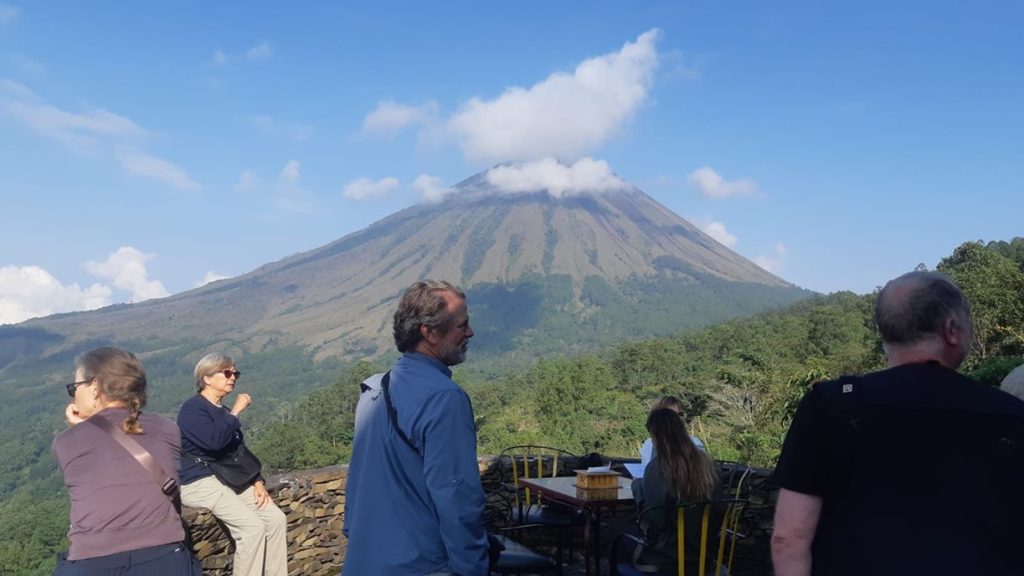
Descend to Bena, beneath the exotic pyramid of Mount Inerie. Here, megalithic masterpieces unfold: towering Sa’o homes stand among bhaga (female ancestor symbols) and ngadhu (male ancestor pillars). Sacredness lives through Rebo rituals.

Higher still, at 1,200 meters in Manggarai, hides *the miracle of Wae Rebo. Seven colossal conical homes (Mbaru Niang) rise 15 meters, cloaked in black palm fiber—an architectural wonder embodying Manggarai cosmology.
Reaching Wae Rebo is pilgrimage: hours climbing steep paths through primordial fog and forest. At the summit, extraordinary peace awaits. Life here bows to elders’ wisdom and nature’s cycles.
These villages are silent teachers of harmony, sacred order, and the presence of ancestors—mediators between Earth, Sky, and the divine.
Faith Rooted Deep
Flores’ traditions thrive today partly through Catholicism’s embrace. The faith’s fusion with local culture births unique expressions, most vividly in pilgrimages and celebrations.
Larantuka’s *Semana Santa* hosts Southeast Asia’s largest silent procession. Statues of Tuan Ma (Sorrowful Mother) and Tuan Ana (Fallen Christ) move through mystical quiet. The hymn Fiat Voluntas Tua in Latin-Lamaholot cloaks the city—a profound meditation on Christ’s passion and devotion to the “Mother of Larantuka.”
Pilgrims journey onward to Nilo Hill near Maumere. Here, the 15-meter *Virgin Mary Guardian of Unity* statue stands—not just a landmark, but a pilgrimage heart. Thousands flock here annually, especially on August 15th (Assumption), creating an atmosphere thick with grace.
Flores’ spirituality flows quietly through retreat houses in contemplative landscapes: Ruteng’s misty coolness, Bajawa’s coffee gardens, or Ledalero’s theological campus (Maumere)—sanctuaries for reflection.
Daily rituals in ancient churches—Larantuka Cathedral, Sikka Natar Church, Ledalero Seminary, Ritapiret (“One-Night Vatican”), Ende Cathedral—pulse with deep devotion. Local prayer languages often slip into liturgy. Faith here breathes with the island’s rhythm, alive with compassion.
Flores Island (1): An Emerald in Nusa Tenggara’s Turquoise Belt
Flores’ Catholicism is a deep well. Its waters are clear universal faith, yet its taste is distinct—mineral-rich with local wisdom, quenching souls thirsty for meaning.
Epilogue: The Timeless River
Flores’ cultural wealth springs from ancient traditions, tinted by Catholic faith, nourishing generations. It lives in the weaver’s patience, the Caci dancer’s courage, the pilgrim’s reverence at Semana Santa, and the wisdom etched in Bena’s and Wae Rebo’s ancestral stones.
This culture lives, breathes, adapts—yet never loses its spirit. Flores calls those seeking not just beauty, but the depths of human resilience and sacred connection, woven into every textile, dance step, and weathered rock. To witness it is to behold life in its rawest, most exquisite, and enduring form.